Beyond the Tourist Bubble: Real Ways to Connect With the People Who Actually Live There
Let's be honest about something: a lot of what gets marketed as 'authentic local experience' is really just tourism wearing a different outfit. The cooking class designed for visitors. The 'hidden gem' restaurant that's on every travel blog. The neighborhood walking tour led by someone whose entire job is to translate a place for outsiders.
None of that is bad, exactly. But it's also not quite the same as genuine connection with the people who actually live somewhere—the ones who aren't performing their culture for your benefit, who have real lives and real opinions and real recommendations that didn't come from a sponsored post.
The gap between tourist interaction and genuine local connection is real. And closing it, even a little, tends to be what separates a trip you remember from one you merely document.
Start Before You Get There
The single biggest thing most travelers skip is preparation—not logistical preparation, but cultural and linguistic preparation. Even a small investment here pays off enormously once you arrive.
You don't need to become fluent in a language to make a real impression. Learning ten to fifteen phrases in the local language—greetings, expressions of gratitude, basic questions, and importantly, the phrase for 'I'm sorry, my [language] is terrible'—signals something important to the people you meet. It says you didn't assume everyone would just accommodate you in English. That matters more than you might expect.
Beyond language, spend some time before you travel reading about current events in your destination. Not just historical context, but what's happening there now. What are people talking about? What are the ongoing tensions, celebrations, frustrations? You don't need to have opinions ready—but knowing enough to listen intelligently is a real asset.
Rethink Where You Eat
Food is one of the most reliable bridges between cultures, and most travelers blow the opportunity by defaulting to restaurants that are either explicitly tourist-facing or heavily reviewed on English-language platforms.
Instead, try this: eat where workers eat. Look for spots with no English menus, where the lunch crowd is clearly made up of locals on a break rather than travelers on a schedule. Point at what the person next to you ordered if you have to. Eat at the counter when there's a counter. These environments naturally invite small interactions—a comment on your food, a nod of approval when you try something unfamiliar—that rarely happen in places designed to serve tourists efficiently.
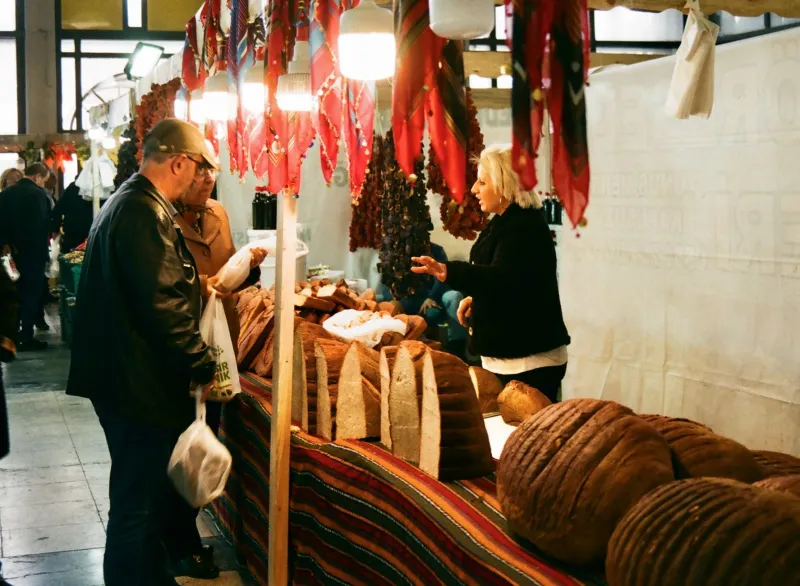
Farmers markets, food halls, and neighborhood bakeries operate similarly. They're not experiences designed for you, which is exactly what makes them valuable.
Learn to Be Useless in Public
This sounds strange, but bear with it. One of the most effective ways to generate genuine interaction with locals is to be visibly, non-threateningly confused about something—and to ask a nearby person rather than your phone.
Asking someone for directions, even when Google Maps could tell you, creates a moment of real human contact. It gives the other person a chance to be helpful, which most people actually enjoy. It often leads to a brief conversation. And it positions you as someone who's curious and engaged rather than a tourist processing the city through a screen.
The key is to ask people who are clearly going about their own day—someone waiting at a bus stop, a shopkeeper between customers, a person reading on a bench—rather than someone who's already in a service role and obligated to assist you.
The Performative Authenticity Trap
Here's something worth naming directly: the pressure to have 'authentic' experiences can itself become a kind of performance. Travelers sometimes get so focused on avoiding anything that seems touristy that they end up making choices based on aesthetics rather than genuine curiosity.
If you genuinely want to visit a famous landmark, visit it. If a local festival happens to be popular with tourists, that doesn't automatically make it inauthentic—it might just mean it's genuinely worth seeing. The goal isn't to avoid anything that other travelers enjoy. The goal is to stay curious and open rather than consuming a place like a checklist.
Real connection with locals doesn't require you to find secret locations no one else knows about. It requires you to show up as an actual person rather than a tourist executing a travel strategy.
Slow Down Your Itinerary
Most meaningful interactions with locals happen in the margins—the conversations that develop when you're not rushing to the next thing. This is almost impossible to engineer if your schedule is packed.
Spending two or three days in a single neighborhood rather than bouncing between highlights lets you become a recognizable face at the coffee shop, the market, the park. That familiarity—even shallow familiarity—opens doors that a single-day visit never will. The person behind the counter starts to treat you differently when you've been in three mornings in a row. The regulars at the bar are more likely to chat when you're not clearly just passing through.
This is one of the strongest arguments for going deeper into fewer places rather than skimming the surface of many.
Practical Tools That Actually Help
A few resources that can genuinely facilitate local connection rather than just simulate it:
-
Meetup.com operates in cities around the world and hosts events organized around shared interests—hiking groups, language exchanges, board game nights—that attract actual residents, not just other travelers.
-
Workaway and Worldpackers connect travelers with hosts who offer accommodations in exchange for a few hours of work per day. The relationship is inherently more reciprocal than a standard hotel stay.
-
Couchsurfing's events feature (separate from the accommodation side) often lists local meetups and cultural exchanges in major cities.
-
Language exchange apps like Tandem or HelloTalk let you connect with speakers of other languages before or during your trip—sometimes leading to in-person meetups with people who are genuinely interested in cross-cultural conversation.
What You're Actually After
The point of all of this isn't to collect authentic experiences as a form of travel credentialing. It's simpler than that: when you connect with the people who live somewhere, you understand the place more fully. You leave with something more than photos and restaurant recommendations. You leave with a sense of what daily life actually feels like there—its rhythms, its humor, its frustrations, its particular beauty.
That kind of understanding changes how you travel, and often how you live when you get back home. It's worth the extra effort it takes to get there.